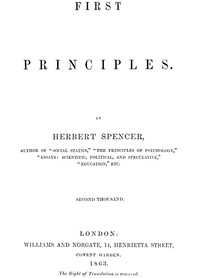
First Principles
Resumen
"First Principles" by Herbert Spencer is a philosophical treatise written in the mid-19th century. The work is part of a larger series that aims to establish a systematic understanding of philosophy grounded in science, religion, and human experience. It explores the interplay between religion and science, seeking to reconcile their seemingly opposing views on existence and knowledge, and discusses the underlying truths present across various belief systems. The opening of the treatise introduces the ambitious scope of Spencer’s work, as he presents a framework for his philosophical inquiry. He begins with a discussion on the nature of human beliefs, suggesting that even widely-held misconceptions may contain elements of truth. By analyzing the historical perspectives on authority and governance, Spencer underscores the evolution of political thought from divine kingship to modern democratic ideals. He proposes that there is a common thread among all religions and philosophies — the acknowledgment of fundamental truths concerning existence that are often obscured by dogma. Thus, the groundwork is laid for his exploration of "the unknowable" and the "laws of the knowable," setting the stage for a deeper analysis of both the limitations and possibilities of human understanding. (This is an automatically generated summary.)
Leer con LingoAudioBook
La apertura directa aún no está conectada. Descarga un EPUB disponible desde su fuente e impórtalo en la app. Esta dirección conserva el ID de Gutenberg.
Libros ↗Derechos y procedencia
Public domain in the USA.
Distribución en la UE no verificada
Materias (6)
- Category: Philosophy & Ethics
- Category: Religion/Spirituality
- Philosophy and religion
- B
- Knowledge, Theory of
- Evolution