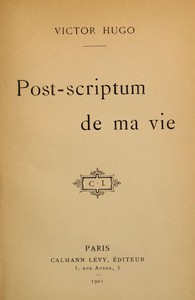
Post-scriptum de ma vie
Summary
"Post-scriptum de ma vie" by Victor Hugo is a collection of posthumous writings, comprised of prose and reflections, written in the early 20th century. The work serves as a literary and philosophical testament, where Hugo shares his thoughts on art, poetry, and humanity, alongside meditations on existence, destiny, and the divine. It encapsulates the author’s insights and critiques as he reflects on the role of the artist and the essence of beauty in relation to the human experience. The opening of this reflective piece presents Hugo addressing contemporary writers, emphasizing the connection between their art and the transformative legacy of the French Revolution. He explores the idea that 19th-century writers are unencumbered by past literary schools, highlighting the originality birthed from historical upheaval. Furthermore, Hugo articulates a profound appreciation for thought and creativity, underscoring the significance of individuality in pursuit of both beauty and truth. As he navigates these themes, Hugo encourages a synthesis of personal and universal explorations, advocating for the role of the artist as both a conscious creator and a participant in the broader human experience. (This is an automatically generated summary.)
Rights & provenance
Public domain in the USA.
EU distribution not verified
Subjects (5)
- Category: French Literature
- Category: Philosophy & Ethics
- Category: Essays, Letters & Speeches
- PQ
- Hugo, Victor, 1802-1885 -- Philosophy